Marrella splendens was the first fossil discovered in the famous Burgess Shale by Charles Walcott. It flourished during the Middle Cambrian period approximately 505 million years ago and remains the most abundant organism within the shale, represented by more than 12,000 specimens.

Growing to approximately 25 mm in length, Marrella possessed a distinctive cephalic shield with two pairs of long backward-sweeping spines that extended across almost the entire body length, possibly serving a protective function. It also featured 24–26 biramous limbs, a pair of long antennae, and large swimming appendages.
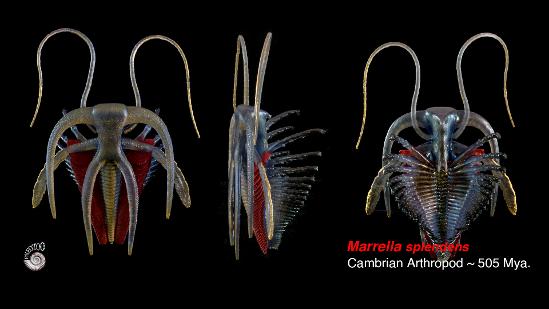
Micro-corrugations preserved along the dorsal surface of the cephalic shield have been interpreted as capable of reflecting iridescent hues. Although only putative eyes have been identified, the presence of colouration and active swimming behaviour suggests that Marrella may have possessed complex visual systems.

Numerous hypotheses have been proposed to explain the rapid increase in biological complexity during the Cambrian period. These include rising oxygen levels that supported larger and more active organisms, the emergence of predation, increased oceanic calcium carbonate enabling the development of hard skeletons and armour, and the evolutionary expansion of sight and mobility — together producing an escalating biological arms race.



With thanks to Assoc. Prof. Diego Garcia-Bellido for feedback on anatomical detail.