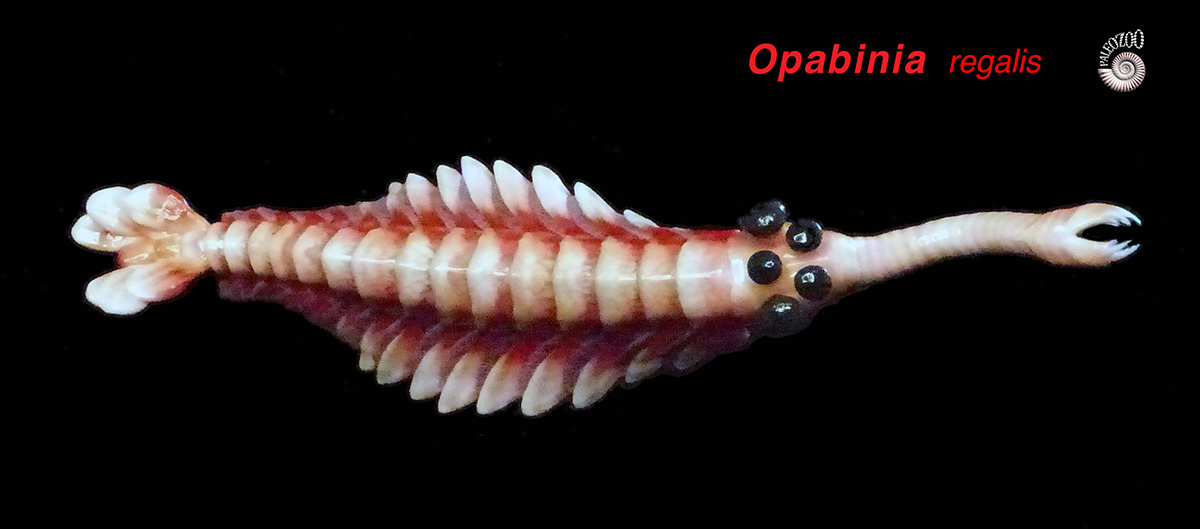
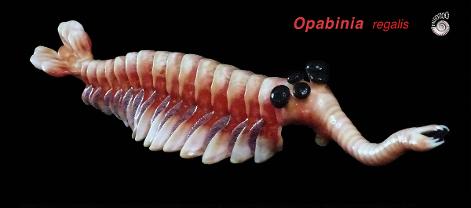
Opabinia regalis is one of the most bizarre animals ever discovered. Living around 505 million years ago during the Cambrian period, it looked like nothing alive today - featuring five stalked eyes, a flexible barbed proboscis, and a series of overlapping swimming lobes along its body.
Opabinia regalis was discovered in the Burgess Shale by Charles Doolittle Walcott, who published the first description in 1912, interpreting it as a possible annelid. A later and much more detailed re-description by Harry B. Whittington in 1975 revealed an animal unlike any living group, making its evolutionary relationships difficult to resolve. That work became one of the defining studies of the Burgess Shale fauna and helped reshape ideas about the remarkable diversity of the Cambrian Explosion.
Opabinia is now generally considered part of a stem group of Euarthropoda, only distantly related to forms such as Anomalocaris.
Even though Opabinia is thought to have been a benthic scavenger it was still probably quite agile and capable of evading predators as it foraged about.
Itis tempting to regard Opabinia and many other extinct Cambrian animals as failed evolutionary "experiments". Yet species generally persist for long periods until environmental change, ecological competition or extinction events alter the balance. Extinction is usually driven by changing circumstances rather than by some intrinsic flaw in an organism's design.
Opabinia may have flourished for millions of years while leaving almost no fossil record. Soft-bodied organisms are only preserved under exceptional conditions, making broad conclusions difficult. Exceptional fossil deposits from around the world show that such animals lived alongside the more readily fossilised biomineralised fauna, and some soft-bodied lineages persisted long after the Cambrian.
The familiar fossil record therefore represents only a small and highly biased sample of the diversity that once existed.
With thanks to Dr Jean-Bernard Caron for oversight of anatomical detail.